Whitney George Artist · Composer
Studio · Brooklyn Contact
Format
Installation · durational
Medium
Sound · light · site
Status
Confirmed presentations
Year
2025 —
CUE · AD01House to out · Hold after hours
People carrying umbrellas along a rain-soaked street at night
W — 014FIG. 02
After hours, a room opens.NOCTURNE
SCENE 01.AFTER DARK

After Dark

A city, listened to after hours.

AFTER DARK is a site-responsive sound installation built from repeated recording walks through a city after dark. Moving through streets, transit systems, businesses, places of worship, private interiors, public gatherings, and the spaces between them, each edition collects a series of partial journeys through a place at hours when its daytime identity has begun to loosen.

The recordings are later brought together inside the installation, where separate places and separate moments are allowed to happen at once.

A night unfolds in multiple directions. The work does not ask to be followed, only entered.

Scene 02

The work

Walking · collecting · recombining

AFTER DARK begins with the premise that a place cannot be understood only by looking at it.

Cities announce themselves visually—through architecture, signage, monuments, maps—but much of their life happens just outside the image: voices behind walls; machinery beginning before dawn; worship; games; traffic; waiting; repetition; interruption; someone else's evening becoming someone else's working day.

Each edition begins on foot.

Some destinations are chosen in advance. Others arrive through chance, circumstance, weather, access, or simply hearing something from around the corner and deciding to follow it. The recordings are not attempts to comprehensively document a city. They are encounters with it—shaped by proximity, curiosity, accident, and the limits of what can be known while passing through.

Inside the installation, these journeys become independent sound sources. Their original chronology dissolves. Places separated by distance, hours, or days begin occupying the same room: morning prayer beside an arcade; a closing shop beside a train arriving somewhere else; rain from one night passing through voices recorded on another.

The city outside is not reproduced.

Something less stable takes its place.

Format
Installation · durational
Medium
Sound · light · site
Year
2025 —
Site specific locations
Wanhua, Taipei - Taiwan
Tokyo, Japan
Kyoto, Japan
Naha, Okinawa - Japan
New York, New York
Scene 03

An atlas of nights

One work · different cities

One work. Different cities. No single way through.

AFTER DARK is an accumulating sonic portrait of cities after hours. Each edition begins with a series of recording walks through a particular place, gathering the sounds of public life, private routines, unexpected encounters, and the hours when one day begins quietly becoming another.

No two cities produce the same work. Each contributes its own recordings, routes, encounters, and exhibition history to an expanding archive of nights.

Select a location to enter its particular version of AFTER DARK.

East Asia · Japan / Taiwan

Tokyo and Kyoto sit a few pixels apart on the world map. Select them in the detail, or from the city list. Each pin is placed from its geographic coordinates.

AFTER DARK: Wanhua

Wanhua, Taipei · September 2026

Field recordings completed · Presented September 2026

Recorded across fifteen walks during the Shinehouse Artist Residency, the first completed edition of AFTER DARK follows Wanhua through the hours when one person’s evening becomes another person’s working day.

Temple voices mingle with arcade machines; scooters pass through conversations; games continue beneath park lights. Between them are footsteps, intervals of waiting, trash collection, rain, machinery, market preparations, and sounds whose sources remain just out of sight.

Familiar streets become strange at a different hour: a doorway opens, an invitation interrupts the route, and the recording briefly enters someone else’s night. Before dawn, the wholesale markets are already at work. The final walk arrives at morning chanting—voices gathering as the darkness thins, carrying the end of one day into the beginning of another.

The score

Fifteen recorded walks, each transferred to cassette. This edition does not use the Choice / Chance / Listening procedure of the later cities.

The installation

For Wanhua, each recorded journey was transferred to cassette: fifteen tapes, each holding one hour of sound across two thirty-minute sides.

The cassettes played independently throughout the installation. Their starting points gradually drifted apart, allowing places and moments that never coincided in the city to meet inside the room.

Night markets crossed morning prayer. An arcade surfaced beside the wholesale market. Bells, rain, footsteps, voices, and machinery continually entered and left one another’s orbit.

On tape, morning is always approaching, and night is never quite over.

Credits

  • AFTER DARK: Wanhua, Taipei · Created, recorded, composed, and installed by Whitney George
  • Development · Shinehouse Artist Residency, Taipei, September 2026
  • Presented · Monga Longshan Cultural & Creative Base, Black Box B2, Wanhua, Taipei

Acknowledgments

With gratitude to Shinehouse for supporting the development of this work, and to the people, streets, businesses, temples, markets, parks, and late-night spaces of Wanhua encountered throughout the fifteen recording walks.

Enter / listen

The spatial listening room on this page is the Wanhua study. Enter the room.

Presentations

Presented September 2026 at Monga Longshan Cultural & Creative Base, Black Box B2, Wanhua, Taipei.

Recording routes. Colored walks, not a ward boundary map.
Explore the Fifteen Walks

Fifteen walks

Wanhua, Taipei
No. Route title When Area Weather
1 The Night Markets of Wanhua Sept. 2 · 7:30–8:45 PM Three night markets around Longshan Temple Mostly cloudy · 29°C · 74–79% RH · windy, 24–30 km/h
Sides
2 Fortunes of the Underground Sept. 3 · 7:00–9:00 PM Underground market at Longshan Temple Sustained light rain / rain · 26°C · ~94% RH · 9–15 km/h wind
Sides
3 Ximen on a Saturday Night Sept. 5 · 9:30–11:00 PM Ximending Partly cloudy, dry · ~26°C · 79–84% RH · 6–11 km/h wind
Sides
4 Siren Songs: Bird Street & Trash Collection Sept. 7 · 7:45–9:30 PM Bird Street and the trash collection route Fair and dry · 24–25°C · 74–78% RH · very light wind, 2–7 km/h
Sides
5 Side Streets & Other People's Evenings Sept. 9 · 8:15–10:15 PM Southern residential streets Light rain easing to showers · 24–25°C · 89–94% RH · 7–9 km/h wind
Sides
6 The Ghost Festival Sept. 10 · 5:30–8:00 PM Longshan Temple and surrounding blocks Light rain until ~6:40 PM, then mostly cloudy · ~25°C · 83–89% RH · 9–17 km/h wind
Sides
7 Central Circle: Wanhua Train Station Sept. 11 · 6:00–8:00 PM Central residential circuit around Wanhua Train Station Drizzle throughout · 26–27°C · 84–89% RH · 11–20 km/h wind
Sides
8 Into the Neon Sept. 12 · 6:15–9:15 PM Longshan to Ximen and back Drizzle/light rain through ~8 PM, then partly cloudy · 27°C · 89–94% RH · 11–20 km/h wind
Sides
9 Game, Set, Match & Other Victories Sept. 13 · 7:45–10:00 PM Youth Park and the southeastern district Mostly cloudy at start, then fair and dry · 27–28°C · 79–84% RH · 17–19 km/h wind
Sides
10 Beyond the Wall & The Long Way Around Sept. 14 · 6:40–9:30 PM Huazhong Riverside Park and Wanda Road Intermittent light rain; brief heavier rain around 8:56 PM; drizzle by the end · ~26°C · ~89% RH · 9–17 km/h wind
Sides
11 Bells, Buttons, & Backstreets Sept. 15 · 5:50–8:30 PM Longshan to Ximen and surrounding areas Mostly cloudy and dry · 26–27°C · 70–79% RH · 13–19 km/h wind
Sides
12 Open Doors & Other Offerings Sept. 16 · 6:30–9:30 PM Interior southern residential loop Partly cloudy → fair; dry · 25–26°C · 61–69% RH · 11–15 km/h wind
Sides
13 While the City Sleeps Sept. 18 · 2:00–5:30 AM Wholesale market and the southern tip Partly to mostly cloudy, dry · ~26°C · ~79% RH · 17–19 km/h wind
Sides
14 Small Departures & the Last Train Home Sept. 18 · 8:30 PM–midnight Ximending and the district boundary Fair and dry · 25–26°C · 74–83% RH · 9–17 km/h wind
Sides
15 Morning Prayers & Other Awakenings Sept. 20 · 5:20–7:30 AM Longshan Temple Mostly/partly cloudy at first; shower risk from ~7 AM · 25→28°C · 70–89% RH · very light wind, 4–6 km/h
Sides

Taipei galleries

Wanhua · September 2026

AFTER DARK: Tokyo

Tokyo, Japan · November 2026–January 2027

Recording in progress · Confirmed exhibitions

In Tokyo, the choice of a railway line determines which parts of the city can enter the same evening. Underground, a neighborhood comes briefly within earshot each time the doors open. Take the stairs, and the scale of the recording changes. What occupied a few seconds on the train can take the better part of the night to cross on foot.

When Tokyo’s first subway opened in 1927, the whole journey lay between Ueno and Asakusa. That stretch of track is still part of the Ginza Line. The Tokyo edition of AFTER DARK takes its shape from this accumulated geography, following subway and surface lines into the streets around their stations, then carrying those streets back into the same room.

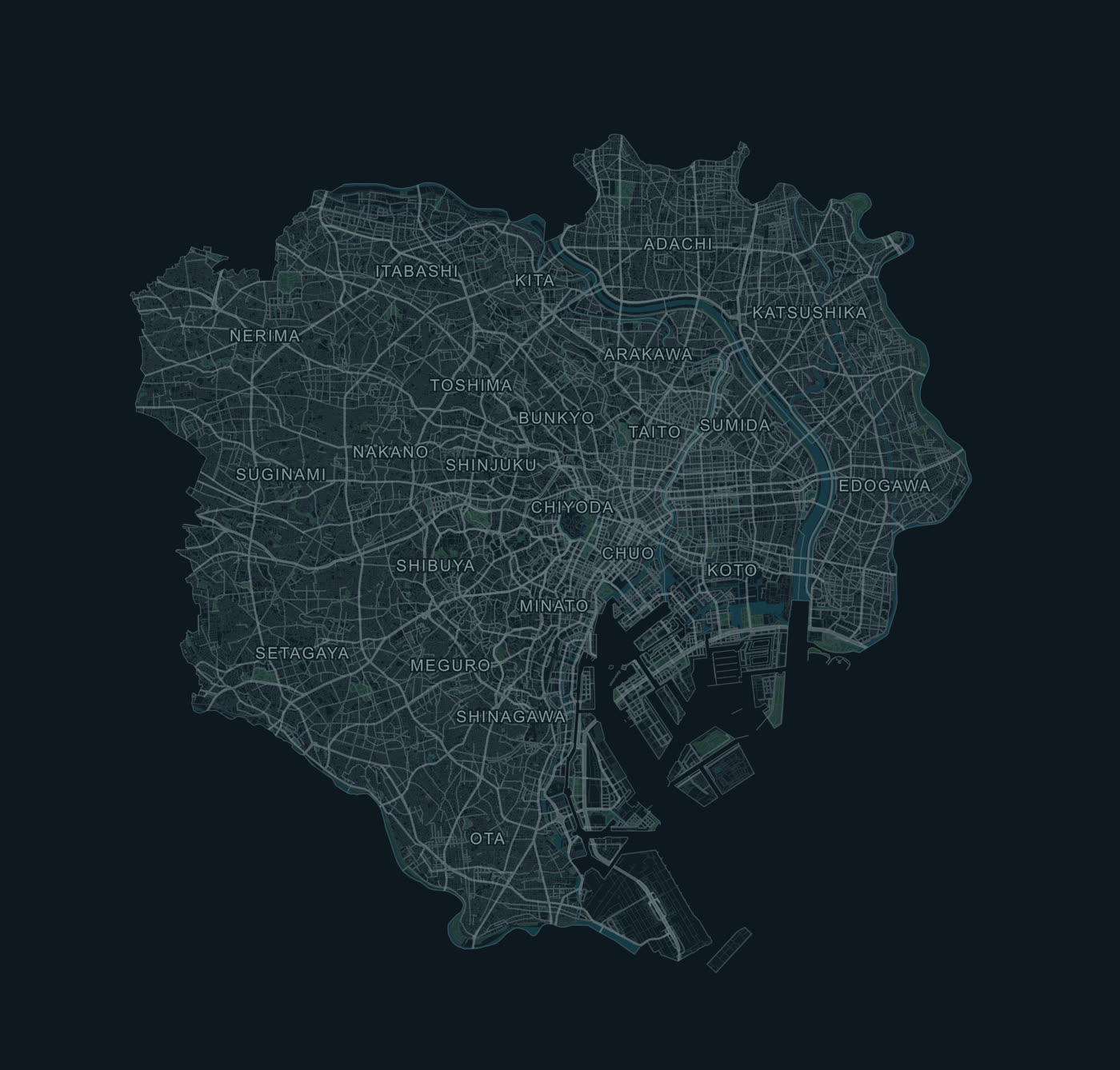
Dark street map of Tokyo’s twenty-three wards, from Nerima and Setagaya to Edogawa and Ota
Tokyo’s twenty-three special wards.

The score

Each walk takes a line as its starting condition. A destination can draw the recording toward one end of it. A stop chosen along the way can turn the evening in another direction. On foot, listening determines how long to stay, which corner to turn, and whether to return to the station or continue on to another.

The lines can cross more than once over the course of the work. A station heard in passing on one journey may be the point of departure on another. In the installation, the recordings run independently, and a listener can linger at that crossing long after both trains have gone.

Enter / listen

This city's listening environment is in development.

Presentations

Design Festa Gallery Harajuku · Nov 23–26, 2026

Gallery Conceal Shibuya · Nov 27–29, 2026

drawCircle Gallery · Dec 2–7, 2026

Room_412 · Jan 2–5, 2027

Full calendar

Completed walks · November 2026

Completed walks · November 2026

No. Neighborhoods covered Date / time Route Weather
01 Ginza / Yūrakuchō / Shibuya / toward Roppongi Tue, Nov 10 · 16:30–23:25 (6h 55m 16s) Kabuki-za, Acts 5–6. From Yūrakuchō, counterclockwise on the Yamanote Line via Tokyo, Ueno, Ikebukuro and Shinjuku. Off at Shibuya and on foot toward Roppongi. Cloudy and dry · 10→8°C · 61–77% RH · NE winds, 8–14 km/h
02 Shinjuku / Ryōgoku / Hikarigaoka / toward Roppongi Wed, Nov 11 · 16:37–21:44 (5h 07m 02s) From Shinjuku at sunset, the Ōedo Line to Ryōgoku’s sumo district, then to the terminus at Hikarigaoka. Return toward Roppongi. Clear and dry · 10–11°C · 62–71% RH · light winds, 6–8 km/h
03 Ueno / Asakusa Thu, Nov 12 · 17:00–22:34:56 (5h 34m 56s) Ginza Line, with walks through Ueno and Asakusa. Dry · 12–14°C · 69–86% RH · winds 2–10 km/h, turning NW by 22:00

AFTER DARK: Kyoto

Kyoto, Japan · December 2026

Recording scheduled · Confirmed exhibitions

Fifteen nights of listening across Kyoto's eleven wards. Guided by CHOICE, CHANCE, and LISTENING, AFTER DARK moves between waterways and station platforms, market edges, narrow streets, and places where ceremonial and ordinary time briefly overlap. The recordings enter a continuously shifting installation without a prescribed beginning or end.

Fifteen Nights. Eleven Wards. No Fixed Destination.

Kyoto has a reputation for stillness, but stillness here is never absolute. Beneath temple gates and between ordinary buildings, trains depart, shutters descend, bicycles pass, and water moves unseen. Across fifteen consecutive nights, AFTER DARK follows these overlapping registers, listening less for an essential portrait of Kyoto than for what happens to be audible at a particular moment.

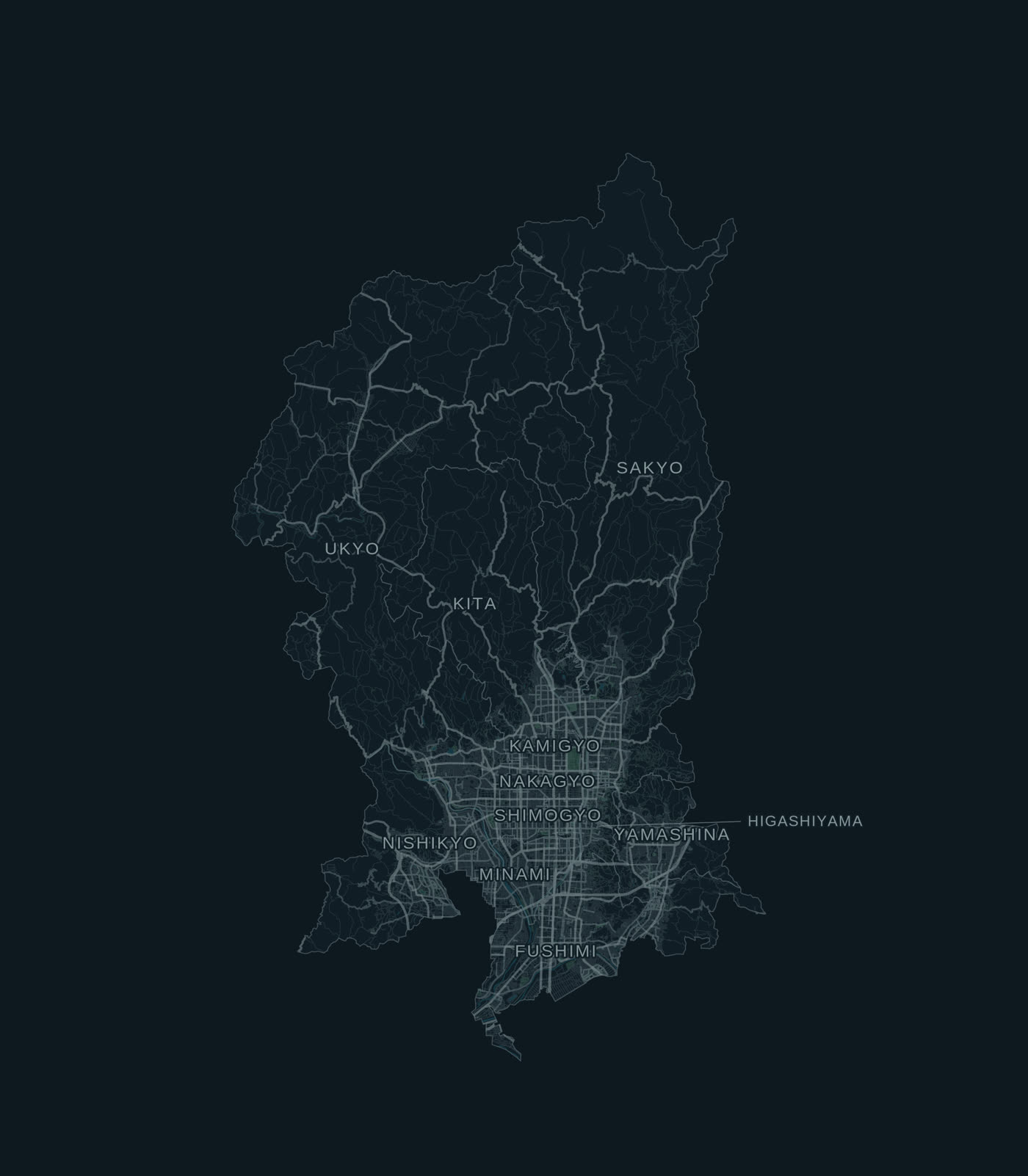
Dark street map of Kyoto’s eleven wards, from Kita and Ukyo to Fushimi and Higashiyama
Ward map of eleven wards. Not a verified recording route. Fushimi, Kamigyō, Nakagyō, and Sakyō are the four wards drawn for a second walk.

About the work

There are many ways to divide a city, and none is neutral. This chapter begins with Kyoto's eleven administrative wards, assigning one recording to each. A chance procedure selects four wards—Fushimi, Kamigyō, Nakagyō, and Sakyō—for a second encounter. The map provides a framework for walking without pretending to describe what a place will sound like.

Between December 9 and 23, 2026, the score proposes fifteen nighttime journeys through station districts, canals, market streets, residential roads, and the edges of ceremonial spaces. The work is concerned as much with the intervals between recognizable destinations as with the destinations themselves: a street behind a shrine, the far side of a railway crossing, the noise that persists after a shop has closed.

The score: Choice / Chance / Listening

Each journey begins with CHOICE: a predetermined destination or sonic condition. CHANCE introduces a location selected through a map-based operation. LISTENING follows—the permission to change direction because something else has become more interesting. A gate rolling shut; the uneven rhythm of footsteps; a train heard through the next block; voices emerging from a room that cannot be seen. The score can establish a route, but it cannot anticipate what will interrupt it.

The installation

AFTER DARK takes the form of fifteen independent listening stations. Recordings cycle continuously, beginning at different points in time; their relationships change as the installation unfolds. Visitors move between stations, approaching one sound as another disappears into the surrounding room. There is no position from which the entire city can be heard, and no prescribed route through the installation.

The fifteen planned recording nights provide source material for the Kyoto edition. The final selection and arrangement of audio will take shape during the installation process; a recording walk is not necessarily a single, fixed playback track.

Enter / listen

This city's listening environment is in development.

Presentations

Atelier Mitsushima · Dec 22–25, 2026

sōma · Dec 26–27, 2026

KAGANHOTEL · Dec 28, 2026–Jan 1, 2027

Full calendar

Recording score — planning archive

Recording score — planning archive

No. Date / time Ward Choice Chance Listening
01 Wed Dec 9
20:30–21:30
Shimogyō 下京区 Kyoto Station perimeter on arrival Draw a public street around the station Arrivals, wheels, announcements, first night
02 Thu Dec 10
21:00–22:00
Nakagyō 中京区 (1/2) Kiyamachi / Sanjō nightlife Draw a side street one block off main strip Bars, alleyways, footsteps, canal
03 Fri Dec 11
18:30–19:30
Higashiyama 東山区 Yasaka / Kōdai-ji public approaches Draw a lane east of Gion's busier blocks Ritual / commerce; footsteps and voices
04 Sat Dec 12
19:30–20:30
Sakyō 左京区 (1/2) Demachiyanagi / Kamo River confluence Draw river crossing or bank street Flowing water, bicycles, students
05 Sun Dec 13
18:30–19:30
Ukyō 右京区 Ninna-ji perimeter / illuminated visitors Draw public road outside temple approaches Last illumination night; crowds into quiet
06 Mon Dec 14
20:00–21:00
Kamigyō 上京区 (1/2) Nishijin textile district / Imadegawa Draw a nearby residential alley Quiet workshops, shutters, homes
07 Tue Dec 15
19:30–20:30
Fushimi 伏見区 (1/2) Fushimi canals / sake-brewing district Draw canal bridge or brewery side lane Water, production edges, nighttime stillness
08 Wed Dec 16
19:00–20:00
Yamashina 山科区 Yamashina Station / residential lanes Draw east or south of station Commuters dissipating into domestic streets
09 Thu Dec 17
18:30–19:30
Nishikyō 西京区 Katsura Station / neighborhood lanes Draw small road toward Katsura River Rail crossings, homes, distant traffic
10 Fri Dec 18
19:30–20:30
Kita 北区 Daitoku-ji perimeter / Kita streets Draw north or west into local grid Low traffic, bicycles, winter quiet
11 Sat Dec 19
18:30–19:30
Sakyō 左京区 (2/2) Okazaki / Heian Shrine public perimeter Draw street between canal and park Cultural precinct / residential contrast
12 Sun Dec 20
20:00–21:00
Nakagyō 中京区 (2/2) Nijō Castle outside / quiet inner city Draw street west or north of castle Distant urban hum vs dark side streets
13 Mon Dec 21
17:30–18:30
Minami 南区 Tō-ji Kōbō-san market dispersal / exterior Draw a nearby street or underpass Stalls packing, traffic, retreating crowd
14 Tue Dec 22
20:30–21:30
Fushimi 伏見区 (2/2) Fushimi Inari public approach / station Draw parallel station road or public lane Trains, travelers, steps into hillside dark
15 Wed Dec 23
19:00–20:00
Kamigyō 上京区 (2/2) Kitano Tenmangū perimeter / backstreets Draw northwestern alley toward neighborhoods Temple edges, shutters, late-year city

AFTER DARK: Naha

Naha, Okinawa · January–February 2027

Recording scheduled · Confirmed February 2027 presentation

Fifteen nighttime walks across Naha, moving between harbors, market streets, residential hills, and the edges of the former Ryukyu capital. Guided by CHOICE, CHANCE, and LISTENING, AFTER DARK gathers the sounds of a city in passing and places them within a continuously shifting installation without a prescribed beginning or end.

Fifteen Walks. Fifteen Territories. No Fixed Path.

The city changes character when its familiar destinations cease to be destinations. In Naha, the sea and the airport are never far away, yet the sound of a place may be carried just as clearly by a side street, a passing monorail, a shutter being lowered, or the distance between two voices. Across fifteen nighttime journeys, AFTER DARK will listen to the city without attempting to hold it still.

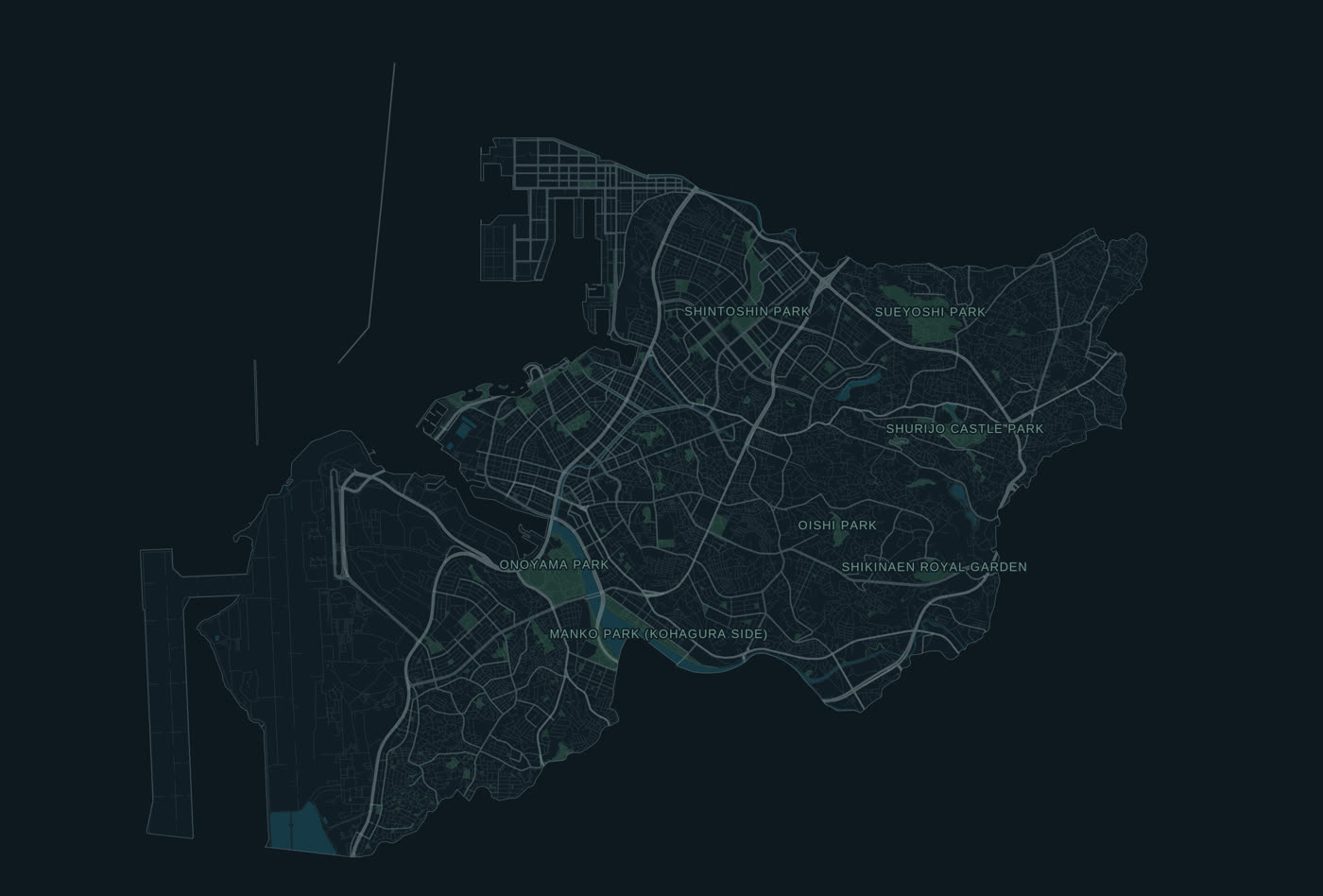
Dark street map of Naha, from the airport and Onoyama Park to Shuri Castle Park and Shikinaen
Street map of planned territories. Neighborhood labels, not verified walk routes.

Naha is both a point of arrival and a place that keeps its own time. Beyond the bright commercial avenues, the city turns toward working harbors, residential hills, narrow market streets, and the remnants of a former royal capital. For AFTER DARK: Okinawa, fifteen nighttime walks are planned across fifteen territories, following a score of CHOICE, CHANCE, and LISTENING. Some routes begin with a destination; others are interrupted by whatever becomes audible along the way. Together, the recordings will form an unstable portrait of Naha—not as a complete map, but as a sequence of encounters that could only have happened on those particular nights.

About the work

This chapter uses fifteen proposed recording territories assembled from a working pool of Naha neighborhood names. They are artistic groupings, not official wards or municipal boundaries. Each territory defines an area of departure, not a requirement to walk through every neighborhood it contains. The city’s official urban planning master plan instead describes nine larger planning regions.

The score: Choice / Chance / Listening

CHOICE establishes a public-space starting point or sonic condition within a territory. CHANCE supplies a turn, street, or secondary waypoint selected from the accessible pedestrian network. LISTENING allows the walk to depart from the drawn route when an unforeseen sound becomes more compelling. A map organizes departures; it cannot decide what deserves attention.

Each field session aims for sixty continuous minutes. The fifteen territories are fixed provisionally, but their recording order may be drawn by chance. Transfers to the start of a territory do not count toward its sixty-minute recording. Final capture dates, starting points, and walking traces will be logged after each session.

The installation

AFTER DARK is conceived as an environment of fifteen independent listening stations. Field recordings cycle continuously, beginning at different points in time; their relationships change as visitors move through the room. No one station provides a complete portrait of Naha, and no sequence determines how the work must be heard.

The fifteen walks are the proposed source material for the Okinawa chapter. The final selection of audio, any accompanying score, and installation configuration will be determined through recording and assembly.

In development: fifteen publicly accessible recording territories in Naha, Okinawa. Field recordings planned for January–February 2027.

Enter / listen

This city's listening environment is in development.

Presentations

Full calendar

15-day recording calendar — planning

15-day recording calendar — planning

Working plan: one uninterrupted 60-minute nighttime recording each day, starting Sunday, January 10, the day after arrival. Dates are fixed provisionally; territory assignments currently follow their reference numbers and have NOT yet been randomized by chance. All start times, night access, and walking paths remain to be verified.

No. Night / date Territory Choice Time / access
01 Sun Jan 10 Northern Port Public streets near port edge 60 min after dark; No cargo-terminal gates
02 Mon Jan 11 New City West Omoromachi / transit corridor 60 min after dark; Check shopping passage hours
03 Tue Jan 12 Tomari / Waterfront Tomari side streets 60 min after dark; No controlled ferry docks
04 Wed Jan 13 Western Naha / Old Port Kume / western street network 60 min after dark; Keep off restricted port land
05 Thu Jan 14 Markets / Old Commercial Naha Makishi / market perimeter 60 min after dark; Markets' interiors may close
06 Fri Jan 15 Southern River District Tsubogawa / accessible river roads 60 min after dark; Verify river path/park hours
07 Sat Jan 16 Eastern Residential Naha Yorimiya / residential grid 60 min after dark; Public sidewalks only
08 Sun Jan 17 Southeastern Naha Kokuba / connected streets 60 min after dark; Verify safe arterial crossings
09 Mon Jan 18 Northern Shuri Ishiminecho / northern slopes 60 min after dark; Check steep sidewalks
10 Tue Jan 19 Western Shuri / Castle Slopes Kinjocho / hillside public streets 60 min after dark; Check dark/uneven paving
11 Wed Jan 20 Historic Shuri Center Tonokuracho / castle-adjacent streets 60 min after dark; Exclude paid/closed castle grounds
12 Thu Jan 21 Eastern Shuri Torihoricho / eastern slopes 60 min after dark; Avoid closed shrine grounds
13 Fri Jan 22 New City East Makabi / residential streets 60 min after dark; Check sidewalk continuity
14 Sat Jan 23 Central Oroku Oroku / rail approaches 60 min after dark; Public rail approaches only
15 Sun Jan 24 Southern Oroku Akamine / southern residential grid 60 min after dark; exclude airport/military land; verify crossings.
Recording territories — planning archive

Recording territories — planning archive

The neighborhood lists are inclusive research pools rather than ordered walking routes. “Listening” notes describe possibilities to seek, not sounds already recorded. All route anchors and nighttime access remain to be verified.

01 — Northern Port

Neighborhoods: Minatomachi / Akebono / Aja / Ameku.

CHOICE / proposed public-space anchor: Public streets on the residential–industrial edge; seek a transition from neighborhood traffic toward port infrastructure.

LISTENING / possibilities: Freight movement at a distance, ventilation, trucks, wind, shifts in road texture.

02 — New City West

Neighborhoods: Mekaru / Uenoya / Omoromachi / Furujima.

CHOICE / proposed public-space anchor: Omoromachi’s public commercial and transit approaches, branching into nearby residential streets.

LISTENING / possibilities: Monorail, crossings, shopping corridors, late-evening dispersal.

03 — Tomari / Waterfront

Neighborhoods: Tomari / Maejima / Matsuyama / Kumoji / Wakasa.

CHOICE / proposed public-space anchor: Use the publicly accessible Tomari-side streets, or a compact urban sub-loop nearby.

LISTENING / possibilities: Ferry traffic heard from outside a facility, water-adjacent streets, nightlife fading into housing.

04 — Western Naha / Old Port

Neighborhoods: Kume / Tsuji / Nishi / Tondocho / Higashimachi / Izumizaki / Asahimachi.

CHOICE / proposed public-space anchor: A smaller loop between older blocks, government/commercial streets, and the coastal approach.

LISTENING / possibilities: Street crossings, restaurants, quieter lanes, vehicle rhythms.

05 — Markets / Old Commercial Naha

Neighborhoods: Matsuo / Makishi / Asato / Tsuboya / Daido / Mihara.

CHOICE / proposed public-space anchor: Kokusai-dori side streets, the public market perimeter, or Tsuboya’s publicly accessible lanes.

LISTENING / possibilities: Arcade edges, nightlife, shop shutters, ceramics district backstreets.

06 — Southern River District

Neighborhoods: Tsubogawa / Onoyamacho / Yamashitacho / Sobe / Kohagura / Higawa.

CHOICE / proposed public-space anchor: Public roadways near the river and adjacent neighborhoods; take a compact loop.

LISTENING / possibilities: Traffic beside water, bridges, sports-ground perimeter, residential nighttime.

07 — Eastern Residential Naha

Neighborhoods: Yogi / Yorimiya / Nagata / Hantagawa / Shikina.

CHOICE / proposed public-space anchor: Residential grid and accessible neighborhood connectors.

LISTENING / possibilities: Domestic interiors audible from public streets, scooters, small intersections, insects.

08 — Southeastern Naha

Neighborhoods: Maaji / Uema / Nakaima / Kokuba.

CHOICE / proposed public-space anchor: Public streets along Kokuba and nearby rising residential blocks.

LISTENING / possibilities: Buses, main-road traffic, quieter off-axis streets, distant machinery.

09 — Northern Shuri

Neighborhoods: Shuri Ishiminecho / Shuri Kubagawacho / Shuri Tairacho / Shuri Onacho.

CHOICE / proposed public-space anchor: Choose connected public streets on the northern Shuri slopes.

LISTENING / possibilities: Evening housing rhythms, school/station corridors, elevation changes.

10 — Western Shuri / Castle Slopes

Neighborhoods: Shuri Sueyoshicho / Shuri Yamagawacho / Shuri Samukawacho / Shuri Kinjocho / Shuri Mawashicho.

CHOICE / proposed public-space anchor: Public streets around Kinjocho and adjacent residential hillside roads.

LISTENING / possibilities: Stone underfoot, wind, footsteps, distant city noise.

11 — Historic Shuri Center

Neighborhoods: Shuri Gibocho / Shuri Akahiracho / Shuri Tobarucho / Shuri Onakacho / Shuri Ikehatacho / Shuri Tonokuracho.

CHOICE / proposed public-space anchor: Freely accessible streets outside the historic/castle precinct; do not make the castle grounds an anchor.

LISTENING / possibilities: Quiet residential sections, monorail vicinity, night air around older streets.

12 — Eastern Shuri

Neighborhoods: Shuri Teracho / Shuri Torihoricho / Shuri Akatacho / Shuri Sakiyamacho.

CHOICE / proposed public-space anchor: Eastern residential slopes and open streets around small cultural sites.

LISTENING / possibilities: Quiet lanes, night insects, abrupt changes in traffic noise.

13 — New City East

Neighborhoods: Makabi / Matsushima / Matsugawa.

CHOICE / proposed public-space anchor: A smaller route through public residential streets east of Omoromachi.

LISTENING / possibilities: Traffic thinning away from arterial roads, homes, neighborhood shops.

14 — Central Oroku

Neighborhoods: Oroku / Kyoharacho / Kanagusuku / Tabaru.

CHOICE / proposed public-space anchor: Public streets near Oroku’s residential/commercial blocks and rail approaches.

LISTENING / possibilities: Monorail, local traffic, late commuters, school/residential rhythms.

15 — Southern Oroku

Neighborhoods: Akamine / Takara / Uebaru / Gushi / Miyagusuku.

CHOICE / proposed public-space anchor: Public road loop in the accessible southern Oroku neighborhoods, not inside the airport perimeter.

LISTENING / possibilities: Aircraft overhead, traffic from wider roads, domestic streets in contrast.

AFTER DARK: New York

Manhattan, New York · October–November 2026

Twenty recording nights completed · Exhibition forthcoming

Twenty Nights. One Island. Countless Departures.

Twenty nights of listening across Manhattan. Following a score of CHOICE, CHANCE, and LISTENING, AFTER DARK moves through streets, parks, subway passages, and the city's less conspicuous hours, gathering fragments of an island that never quite falls silent. These recordings become part of a continuously shifting installation in which each visitor finds a different route through the night.

A city is never entirely awake, and never entirely asleep. Across twenty recording nights in Manhattan, AFTER DARK follows the streets, parks, stations, tunnels, bridges, and incidental encounters that unfold after the day's official business is supposed to be finished. The result is not a definitive sound map, but a portrait of the island as it happened to reveal itself—at a particular hour, on a particular evening, to someone who happened to be listening.

About the work

There are countless ways to divide a city: by neighborhood, by history, by the invisible boundaries separating one kind of life from another. Here, the map offers a point of departure rather than a border. Routes intersect, streets return, and familiar locations take on different characters when approached at another hour or from another direction. Even a crossing made a thousand times can become strange when the destination is no longer the point.

Recorded between October 9 and November 4, 2026, the New York chapter follows twenty separate journeys through Manhattan—from Inwood and Washington Heights to Harlem, Central Park, the East and West Sides, Midtown, the villages, Chinatown, and the southern waterfront. Some passages unfold on foot; others take place inside trains or vehicles. Movement between locations is part of the acoustic experience, not merely the space between recordings.

The score: Choice / Chance / Listening

Each journey begins with CHOICE: a predetermined destination or sonic condition. CHANCE follows, introducing a location determined by a map-based operation. Then comes LISTENING—the permission to depart from the route in pursuit of whatever calls for attention. Voices passing through open windows; machinery working behind a shuttered storefront; a distant siren, an overheard fragment, the brief silence between trains. The procedures set events in motion, but they cannot anticipate what the city will offer.

The installation

AFTER DARK is conceived as an environment of fifteen independent listening stations. Recordings cycle continuously, each beginning at its own point in time; their relationship changes as the installation unfolds. Visitors compose an experience by moving between stations, drawing nearer to one sound while another recedes. No single position provides the whole city, and no two passages through the room need be the same.

The twenty field-recording nights form the source material for the New York edition; they should not be confused with twenty simultaneous stations or a fixed route that visitors must follow. The final selection and presentation details will be determined for the exhibition.

Published Manhattan routes. Colored paths, not a new GPS trace.
Explore the twenty nights

Some dates and times in this log come from GPS screenshots or nearby weather stations, not from confirmed audio timestamps. Those are not treated as verified recording starts. Weather stays in the units of the original notes.

Twenty nights

Manhattan
No. Neighborhoods covered Date / time Route Weather
1 Yorkville / Carnegie Hill Fri Oct 9, 2026, 6:55–10:55 PM Yorkville and Carnegie Hill. Clear; ~68→60°F; calm/light wind
2 Chinatown / Bowery / East Village / Lower East Side Tue Oct 13, 2026, ~9:27 PM – Wed Oct 14, ~12:29 AM Grand Street north along Bowery toward E 14th St, east through East Village, then south and across Manhattan Bridge to Brooklyn. clear, ~69–70°F; light winds
3 Chelsea / Garment District / SoHo / Chinatown Wed Oct 14, 2026, 9:30 PM – Thu Oct 15, 2026, 12:30 AM Chelsea grid loops roughly W 14th–34th St, then south via SoHo / Chinatown to Manhattan Bridge and Brooklyn. clear, approximately 70→64°F; WNW winds with gusts up to ~17 mph late
4 Central Park / Midtown Thu Oct 15, 2026, ~6:38–10:16 PM Park paths around Reservoir, north and south Central Park; southbound extension through Midtown. clear, dry, ~58–59°F during walk; calm/light wind (~0–7 mph)
5 Lenox Hill / Upper East Side / Midtown East Fri Oct 16–Sat Oct 17, 2026, ~6:14 PM–1:20 AM Loops east of Central Park in the 60s–70s, around Park Avenue Armory; extended south through Midtown, downtown and into Brooklyn. ~71→63–64°F; light rain/mist near 7 PM and rain near 10 PM; mostly light winds
6 West Village / Greenwich Village / SoHo Sat Oct 17–Sun Oct 18, 2026, ~9:58 PM–1:01 AM Dense loops around Washington Square / NYU and West Village; south through SoHo, east toward Lower East Side, then across Manhattan Bridge. clear, ~46°F at 10 PM → ~44°F near 1 AM; light/variable winds (around 0–6 mph)
7 SoHo / Nolita / Bowery / Lower East Side / Two Bridges / Corlears Hook Sun Oct 18, 2026, ~6:34–11:37 PM Sara D. Roosevelt Park vicinity and Corlears Hook waterfront; continued via Manhattan Bridge into Brooklyn. clear, ~54→51°F, calm/light winds
8 Inwood / Inwood Hill Park Mon Oct 19, 2026, ~6:18–10:06 PM Concentrated northern-Manhattan loops around Inwood / park vicinity. ~58°F at 6 PM, 56°F at 7 PM, 55°F at 8 PM, 54°F at 9 PM, 53°F at 10 PM; calm/light winds (0–3 mph), no precipitation reported
9 Central Harlem / East Harlem (El Barrio) Tue Oct 20–Wed Oct 21, 2026, ~9:37 PM–12:59 AM Car-based recording; dense grid of streets in Central and East Harlem, including stretches approaching the Harlem River. clear, dry; ~59°F at 10 PM, 57°F at 11 PM, 56°F at midnight, 55°F near 1 AM. Light variable/NNE winds ~5–9 mph
10 Midtown East / Murray Hill / Turtle Bay / Rockefeller Center Wednesday, October 21, 2026 Loops among Midtown East streets between roughly E 34th and the low 50s, near Rockefeller Center and Murray Hill / Turtle Bay. partly cloudy and dry, roughly 55→54°F from 8–10 PM; N/NNE wind near 9–10 mph
11 Hell's Kitchen / Theater District / Lincoln Square / Midtown West Thursday, October 22, 2026 Loops in Hell's Kitchen, Lincoln Square and the Theater District / Times Square, including W 34th–59th Streets and Garment District margins. generally clear/dry; approximately 64→57°F from 6–10 PM, northerly winds
12 Kips Bay / Rose Hill / Gramercy / Sutton Place vicinity / Midtown East Saturday, October 24, 2026, ~7:02–10:17 PM Concentrated East Side loops in Kips Bay (approx. E 23rd–34th St) and Rose Hill / Gramercy (approx. E 17th–29th St), with more loops in Midtown East near the East 50s/Sutton Place vicinity. clear and dry; approx. 57°F at 7 PM → 53°F at 10 PM, light WSW/SW winds around 1–2 mph
13 Washington Heights / Hudson Heights / Fort Washington Monday, October 26, 2026, ~6:09–10:17 PM Concentrated loops around Fort Washington Avenue and surrounding Washington Heights / Hudson Heights streets, from the George Washington Bridge vicinity toward Fort Tryon Park, with southern extension approaching Hamilton Heights. generally clear to partly cloudy and dry; approximately mid-60s°F early evening, falling to ~58°F around 10 PM and ~56°F by 10:51 PM; winds light to moderate
14 Upper West Side / Manhattan Valley / Riverside–Central Park West corridor Tuesday, October 27–Wednesday, October 28, 2026, ~10:01 PM–1:56 AM Concentrated street-grid loops west of Central Park, approximately W 75th–110th Streets, among Broadway, Amsterdam, Columbus and Central Park West. clear and dry; ~52°F at 10–11 PM, ~51°F at midnight, and near 46°F at 1 AM; calm to very light winds
15 Sugar Hill / Hamilton Heights / Manhattanville / Morningside Heights Wednesday, October 28, 2026, ~6:28–10:43 PM Concentrated west-side loops approximately W 110th–155th Streets: Sugar Hill and Hamilton Heights residential grid, Manhattanville near W 125th St, and Morningside Heights around Columbia University. dry evening, roughly 55–58°F, light or calm winds
16 Central Harlem / Lenox Avenue corridor / Mount Morris Park vicinity / Jackie Robinson Park vicinity Thursday, October 29–Friday, October 30, 2026, ~7:23 PM–12:20 AM Audio captured for 4h57m, including part of the B train journey. Concentrated street-level loops approximately W 110th–155th Streets, along Central Harlem avenues and residential cross streets around Marcus Garvey Park and Jackie Robinson Park.
17 Tribeca / Civic Center / Financial District / Battery waterfront / Chinatown fringes Friday, October 30, 2026 Concentrated loops through Tribeca, Civic Center / City Hall, Financial District and southern Battery waterfront, with eastward passages through Chinatown / Two Bridges and a Brooklyn crossing. generally clear/mostly clear and dry; about 55–58°F around 8 PM, cooling to ~53–55°F by 11 PM; northwest winds, sometimes breezy (~7–15 mph)
18 East Harlem / Upper East Side / Midtown East Monday, November 2, 2026 Concentrated loops in East Harlem near E 96th–125th Streets, including avenues east of Central Park, and a second cluster around Midtown East / East 50s. clear, dry; approximately 61°F at 7 PM, 59°F at 8 PM and 57°F at 10 PM, with light winds
19 Lincoln Square / West 50s–70s / Hell's Kitchen / western Upper West Side Tuesday, November 3–Wednesday, November 4, 2026 Concentrated loops west of Columbus Circle in the W 50s–60s, near Ninth–Twelfth Avenues, and farther north through Lincoln Square / West End Avenue around W 70th–79th Streets. dry evening and early overnight, with variable cloud cover; approximately 60°F around 10 PM, easing toward 57–58°F after midnight; generally light winds (~4–6 mph)
20 Koreatown / NoMad / Flatiron District / Union Square / High Line (from W 30th Street) / Far West Side / Midtown Wednesday, November 4, 2026 Route through Midtown South from the Koreatown / Empire State Building vicinity through NoMad, Flatiron and Union Square, plus Far West Side and Midtown passages. Walking on the elevated High Line, starting at the West 30th Street entrance.

Enter / listen

This city's listening environment is in development.

Presentations

Exhibition forthcoming

Full calendar

Scene 04

The listening room

Wanhua spatial study
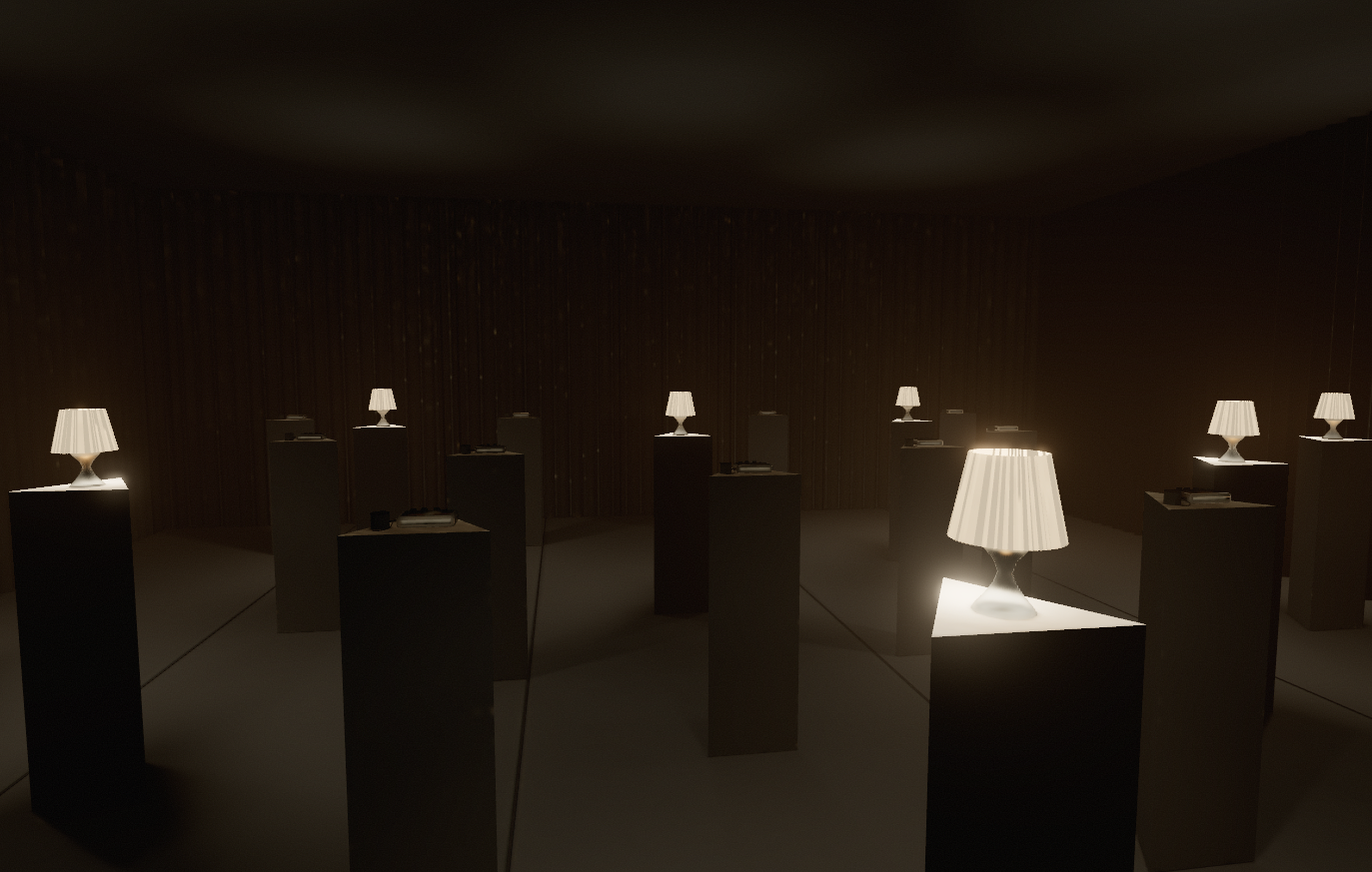
A dark room of triangular pillars, glowing lamps, and clear cassette players. Room study · Wanhua, Taipei
An interactive listening room

Step into the sound.

Move among fifteen recordings. Hear separate nights meet, overlap, and drift apart as you find your own way through the room.

Headphones recommended · Sound starts when you enter.

A spatial study of the installation, with a provisional arrangement of the Wanhua recordings.

After Dark · Listening room

Scene 05

Presentations

Confirmed · not tentative

All times JST

Tokyo / November 2026

Design Festa Gallery Harajuku

WEST 2-D · Harajuku, Tokyo

Monday, November 23, 2026 2:00–8:00 PM
Tuesday, November 24, 2026 11:00 AM–8:00 PM
Wednesday, November 25, 2026 11:00 AM–8:00 PM
Thursday, November 26, 2026 11:00 AM–8:00 PM

Confirmed · Free admission

Tokyo / December 2026

drawCircle Gallery

Kōtō-ku, Tokyo

Wednesday, December 2, 2026 3:00–7:00 PM
Thursday, December 3, 2026 1:00–7:00 PM
Friday, December 4, 2026 1:00–7:00 PM
Saturday, December 5, 2026 1:00–7:00 PM
Sunday, December 6, 2026 1:00–7:00 PM
Monday, December 7, 2026 1:00–5:00 PM

Confirmed · Free admission

Kyoto / December 2026

Atelier Mitsushima

Kyoto

Tuesday, December 22, 2026 2:00–6:00 PM
Wednesday, December 23, 2026 2:00–6:00 PM
Thursday, December 24, 2026 2:00–6:00 PM
Friday, December 25, 2026 2:00–6:00 PM

Confirmed Visit website

sōma

Nakagyō-ku, Kyoto

Saturday, December 26, 2026 2:00–6:00 PM
Sunday, December 27, 2026 12:00–6:00 PM

Confirmed Visit website

KAGANHOTEL

B1 Gallery · Shimogyō-ku, Kyoto

Monday, December 28, 2026 Hours to be confirmed
Tuesday, December 29, 2026 Hours to be confirmed
Wednesday, December 30, 2026 Hours to be confirmed
Thursday, December 31, 2026 Hours to be confirmed
Friday, January 1, 2027 Hours to be confirmed

Confirmed Visit website

Tokyo / January 2027

Room_412

Shibuya, Tokyo

Saturday, January 2, 2027 11:00 AM–8:00 PM
Sunday, January 3, 2027 11:00 AM–8:00 PM
Monday, January 4, 2027 11:00 AM–8:00 PM
Tuesday, January 5, 2027 11:00 AM–8:00 PM

Confirmed Visit website

Naha, Okinawa / February 2027

Naha Cultural Arts Theater NAHArt

Exhibition Room · Naha, Okinawa

Thursday, February 4, 2027 1:00–8:00 PM
Friday, February 5, 2027 11:00 AM–6:00 PM

Confirmed

Scene 06

Archive · acknowledgments

Credits stay with the edition

Edition credits stay in the city panel they belong to. Wanhua names Whitney George and the Shinehouse Artist Residency. Those credits are not applied to Tokyo, Kyoto, Naha, or New York.

Photographic credits stay on the gallery cards. Steven Vigar is named on the Wanhua sets that print his name. The on-site black-and-white set does not name a photographer, and none is assigned here.

The recording method is kept with the Tokyo score, where it is written. The premise of the work remains in Scene 02.