
Whitney George Artist · Est. 2011
Jul 31–Aug 31 · ThinkOlio Get directions
CUE · EV01Pick up the phone · Stay quiet
July 31–August 31, 2026 · Brooklyn

EAVESDROPPING ThinkOlio Lighthouse · 603 Bergen St

On view
Jul 31–Aug 31
Access
Lighthouse business hours
Closing Olio
Fri · Aug 28

Free and open to the public. One rotary phone at ThinkOlio Lighthouse, plus a 24/7 telephone line.

EAVESDROPPING poster mapping the characters around a telephone line open 24/7
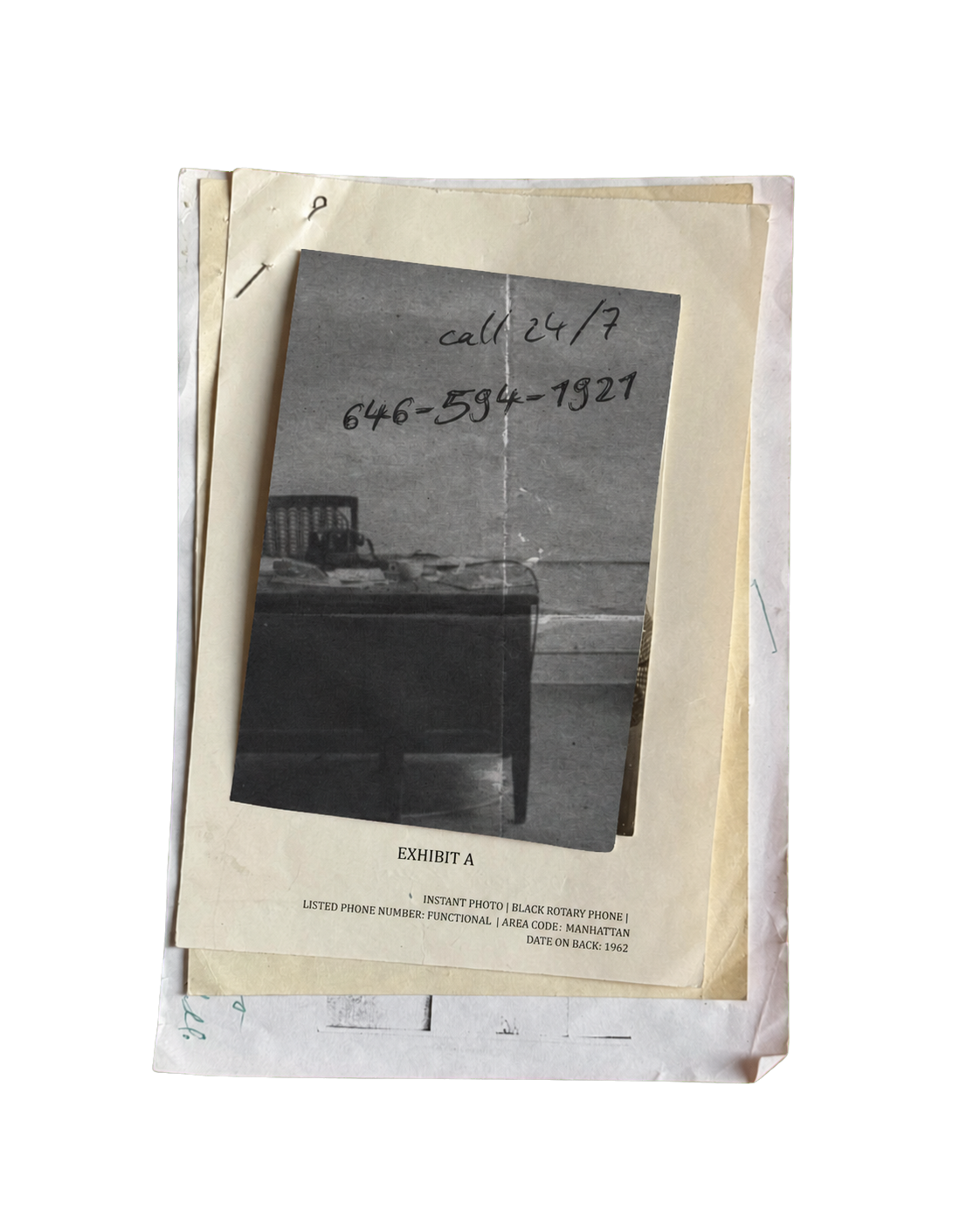
Exhibit A: archival papers and an instant photograph of a black rotary phone, marked with the installation phone number
Exhibit A · Listed line · Manhattan · 1962
SCENE 01.The forbidden pleasure of listening in

Eavesdropping

Eavesdropping is an interactive telephone installation and performance system built from private calls, recorded evidence, fictional archives, and the unstable intimacy of being overheard. A listener picks up a phone and enters a conversation already in motion: two voices trying to understand a room, a number, a set of objects, and the strange consequences of being connected.

Part installation, part game, part haunted archive, Eavesdropping asks what happens when listening becomes participation—and when a private line starts behaving like a door.

In its installation form, Eavesdropping runs as a continuous telephone experience. The line is open 24/7. Callers and visitors encounter fragments from a private story that has already begun, may never end, and seems to change depending on who is listening.

The telephone work remains open around the clock: 646-594-1921.

Scene 02

Part performance, part documentation, part séance.

The project
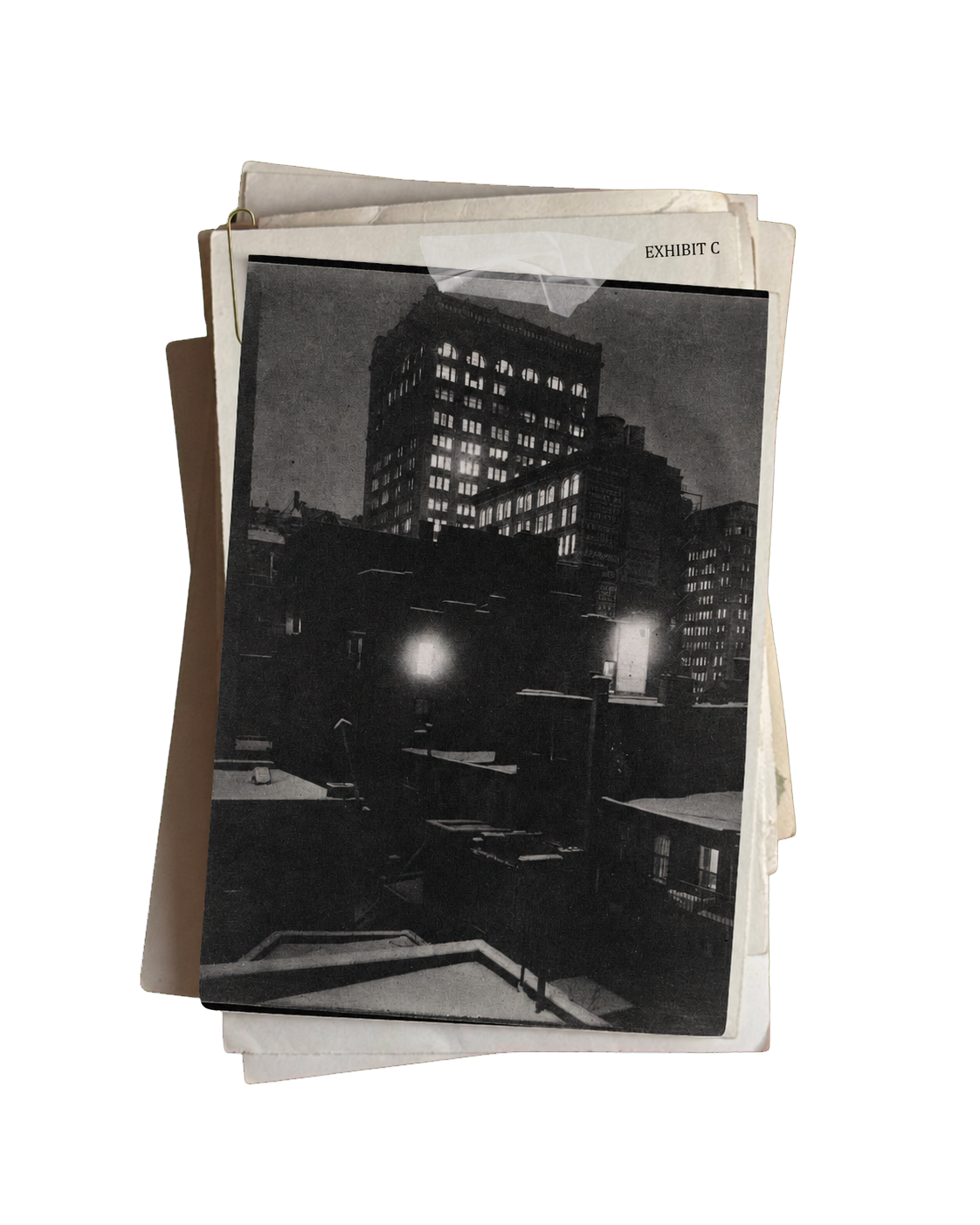
Exhibit C: a stack of archival papers holding a nighttime Manhattan rooftop photograph
Exhibit C · Rooftop evidence · Manhattan

Project description

Eavesdropping begins with a simple instruction: Pick up the phone. Stay quiet.

On the other end of the line, a private conversation is already underway. The listener has not been invited into it, but the system makes room for them anyway. The pleasure is immediate and illicit: to listen without being seen, to enter intimacy without consent, to become a witness before anyone has agreed to be witnessed.

The work is generated through a live narrative system involving performers, phone calls, voicemails, photographs, cassette tapes, letters, found objects, and recorded fragments. Across a 15-day game structure, participants receive evidence boxes, instructions, private messages, and assignments that produce the audio archive heard in the final installation. Their calls are not scripted in the traditional sense; they are prompted, pressured, interrupted, and recorded. What emerges is part performance, part documentation, part séance.

At the center of the work is a room that may not stay in one place or one time. It leaves traces where it has been and premonitions where it may be going. A photograph, a phone number, a pearl, a book, a tape, a matchbox, a dead line, a voice that should not still be reachable: each object becomes both clue and trap. The archive does not explain the room so much as teach the listener how to listen for it.

Audience experience

A visitor encounters a phone. They pick up the receiver. A call is already happening.

The visitor is asked to remain quiet, but quiet is not the same as neutral. Breathing, hesitation, laughter, and the desire to keep listening all become part of the encounter. The work places the audience inside the ethics of overhearing: the thrill of access, the discomfort of intrusion, and the creeping realization that the line may not distinguish between witness and participant.

Depending on the installation format, the audience may encounter Eavesdropping through a physical telephone, a public phone number, a recorded line, a room-like environment, or a constellation of evidence: photographs, tapes, notes, transcripts, objects, and traces left behind by the fictional system that produced the audio.

The listener does not solve the story. The listener enters it.

Scene 03

The phone is always eavesdropping.

System · mechanics · archive

System / mechanics

Eavesdropping is built through a staged narrative game, and a constraint that helps build the archive: the phone is always eavesdropping.

In Season 1, two central participants move through a 15-day sequence of calls, prompts, private instructions, and physical evidence. Each participant receives a box of objects connected to their character: books, scent vials, photographs, tapes, notes, personal effects, and artifacts that may be memory, clue, or contamination. The players are asked to record calls, make audio notes, photograph evidence, respond to voicemails, and decide what to reveal or withhold from one another.

The system is intentionally asymmetrical. Each player knows things the other does not. Each receives different objects, different instructions, and different fragments of the story. Their trust is not assumed; it is generated through contact, misrecognition, suspicion, and need.

The resulting installation archive is made from the material they produce: recorded calls, passive audio, voicemail, transcription, object handling, environmental sound, photographs, and written notes. Fiction and process are not separate layers.

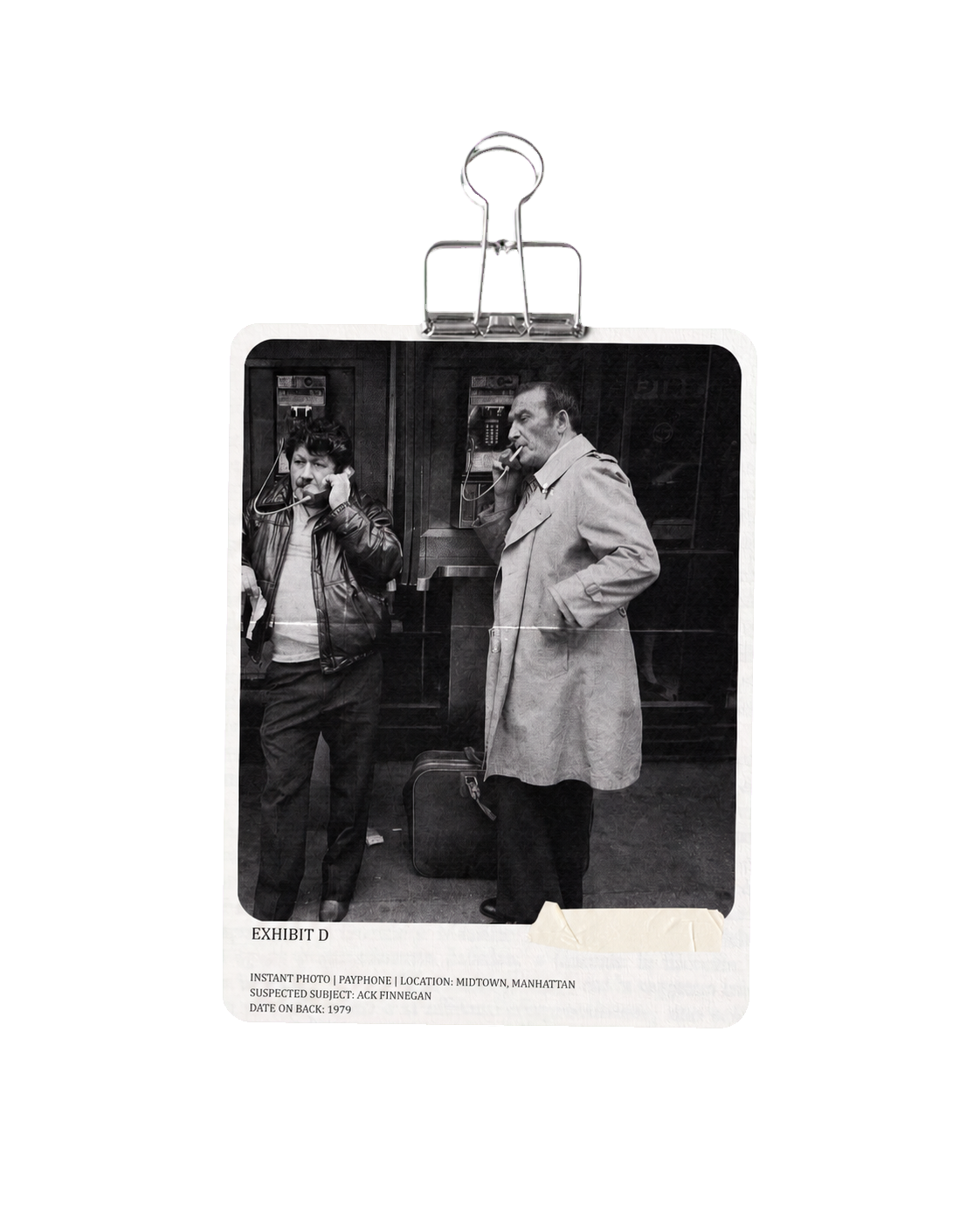
Exhibit D: a clipped archival photograph of two men using public payphones in Midtown Manhattan
Exhibit D · Suspected subject · Midtown · 1979
Scene 04

Season one: the line already exists.

Episodes 01–16

EAVESDROPPING unfolds as a serialized telephone work: part installation, part narrative game, part evidence archive. Each episode gathers calls, voicemails, photographs, objects, transcripts, and private instructions into a story that can be entered by listening.

01 · I Am Sitting in a Room

Run time · 23 minutes

Iris Wren is alone with a photograph from an archive: a Manhattan room, a window, a table, a black telephone. On the back is a handwritten number. She tells herself she is making a catalogue note, but the image has already become an instruction.

Elsewhere, Alexander Vail is alone in a Manhattan room that is not fully his. There is an old black telephone on the table. He has been told not to answer it if it rings. He tells himself he is conducting a sound test, but the test is also a delay, a confession, and a way of listening for the thing he has been warned against.

They have not spoken yet. The line already exists between them.

02 · The Call

Run time · 22 minutes

The phone rings.

Alexander answers a phone he was told not to answer. Iris has called the number attached to the photograph. Neither of them expected the other person to sound real.

At first, the call can almost be mistaken for a wrong number: an old listing, a misdial, an archival mistake, a number copied incorrectly. But Iris knows there is a black telephone in the image, and Alexander is standing close enough to one for the overlap to become dangerous.

They do not explain enough. They do not hang up quickly enough. The call becomes the first tiny violation both people agree to continue.

03 · Can a Dead Line Ring?

Run time · 16 minutes

The call is over, but the room and the photograph no longer feel still.

Alexander makes a technical note, or tries to. Instead, he leaves a message for Jack Finnegan and asks the question he cannot make sound reasonable: can a dead line ring?

Iris makes a file note, or tries to. Instead, she leaves a message for Mara Kline and asks whether a phone number on the back of a print can be considered cataloguing information.

Neither message explains everything. Both recordings become contaminated by what each person almost admits: that the call may have been impossible, that the other voice felt real, and that part of them is already listening for the line to open again.

04 · The Official Record

Run time · 26 minutes

Iris and Alexander try to make the first call ordinary by bringing in witnesses. It does not work.

Jack Finnegan returns Alexander’s message with a warning that refuses to stay technical. Mara Kline answers Iris with the calm of someone trying to keep a strange image inside the language of cataloguing, even as that language begins to fail. Neither Jack nor Mara has the whole story, but both hear enough underneath the questions to become part of the line.

By the time Iris and Alexander reach each other again, the call is no longer a private accident. It has acquired witnesses, records, cautions, and echoes. The room and the photograph have begun to extend outward, touching the people each of them trusted to make the situation seem reasonable.

05 · Do Not Normalize

Run time · 35 minutes

Iris and Alexander speak again, and the questions become more personal. Where are you? Where do you live? What kind of room are you in? What kind of person answers a phone he was told not to answer?

Iris seems more willing to cross the distance between them. Alexander is more careful, less sure what information is safe to give away. The line begins to feel less like a wrong number and more like a private room.

Jack Finnegan leaves Alexander a second message. There was a previous tape. There was a room. There was a receiver test. There was a warning not to normalize what happened.

Elsewhere—or perhaps at a different time—Jack records a supplemental field note for Audio Services Review. The room, he warns, does not seem to need a lease or room number. What it requires is worse.

06 · The Message Came Back

Run time · 35 minutes

Iris and Alexander are alone again, but less privately than before.

Each of them has received a reply. Mara answers Iris from the world of photographs, cataloguing, and professional calm. Jack answers Alexander from somewhere closer to damaged tape, dead lines, and warning. Neither reply solves the problem. Both make it harder to pretend the first calls were contained between two strangers and a phone.

In separate voice memos, Iris and Alexander try to make their witnesses smaller than they are. They replay what was said, what was understood too well, what was misunderstood, and what part of the message refuses to stay reasonable. A reply is not an answer. A reply means the room has acquired edges.

Elsewhere, Maurice Shafer leaves a record of his own: a threshold report about the room, the Bureau’s interest in it, and the danger of treating impossible listening as a tool. If Jack and Mara make the situation personal, Shafer makes it institutional.

By the end of the episode, the line has more than voices on it. It has witnesses, files, warnings, and people beginning to understand that listening may already have made them part of the evidence.

07 · The Same Present

Run time · 42 minutes

Iris and Alexander return to the line with more than curiosity between them. For the first time, they exchange full names, admit they have each brought someone else into the mystery, and discover that those outside witnesses may not be outside at all. Iris has called Mara. Alexander has called Jack.

The trouble is that Jack is not new to Iris; he belongs to an older, stranger history involving a pearl sealed in a bottle, a gesture that felt like a proposal to something more permanent—and more terrible—than marriage.

As Iris and Alexander begin comparing physical evidence, the room stops feeling like a shared question and starts acting like a strange trap. By the end of the call, neither of them can say with confidence what year it is, or whether they have been speaking from the same present all along.

08 · a Line Left Open

Run time · 35 minutes

A voice from the past enters the record: Maurice Schafer delivers an audio report on the room, describing it less as a fixed location than as an arrangement—something that may not require a proper address, only the right conditions, the right listeners, and a line left open long enough to be answered.

Meanwhile, Alexander, now aware that Jack Finnegan and Iris Wren are connected, calls Jack and asks what he knows about her. Jack calls back with a long, uneasy message—part confession, part warning—revealing enough of his history with Iris to make him impossible to dismiss, but not enough to make him trustworthy.

Elsewhere, Mara reaches out to Iris with her own version of the past: Jack, the old wound, the evidence of intimacy, and the possibility of contact. She has an email address for him, but she will only give it if Iris asks.

By the end of the episode, Jack is no longer simply a name shared between them. He has become a threshold: between past and present, warning and seduction, the room and whatever waits outside it.

09 · The Transfer

Run time · 36 minutes

Iris and Alexander return to the room line already suspicious of it, but still needing what it makes possible: contact, comparison, proof. Their conversation turns toward Alexander’s work and the growing suspicion that his professional world—recording, listening, technical evidence, damaged media—may have more to do with the room than either of them wants to admit. While they try to reason through what Jack has told him, the line begins to break open. Both Iris and Alexander hear the interference: Jack reaching through, not quite present and certainly not safely past.

Because the line is no longer subtle about being unsafe, they move to Iris’s private phone to continue——but leaving the room line does not cleanly remove them from the room. On the new line, Alexander shares more of Jack’s warning and the critical evidence he has been given: the room may not need an address, the phone may only be one threshold, and whatever has been speaking through Jack may understand them better each time they answer.

Elsewhere—or earlier, or later—Jack Finnegan and Maurice Shafer each leave reports on the room. Their records do not fully agree, but they rhyme too closely to dismiss. The episode becomes less about whether the room is real, and more about whether every attempt to document it has already become part of its design.

10 · The Present Tense

Run time · 78 minutes

Alexander begins with a simple task: make a record of the present. Date, time, location, objects, sounds, the condition of the line, the behavior of the tape. He speaks like someone trying to catalog the here and now carefully enough that it will stay still. The audio report is practical at first, almost procedural, but desperation keeps entering the recording through small corrections, repeated checks, and the need to prove that the room, the phone, and his own voice still belong to the same world.

What Alexander is really documenting, though, is harder to name. Beneath the report is Iris: every conversation they have had, every hesitation, every moment where a voice begins to feel like evidence of a face he has not seen. The more he tries to describe the room, the more the room seems to describe what Iris has become to him: evidence, danger, witness, and possible escape.

By the end of the episode, Alexander’s attempt to capture the present has become something more intimate and less stable. The tape does not simply preserve where he is. It preserves what he cannot stop listening for.

11 · Distrust & The Distress Signal

Run time · 36 minutes

Iris and Alexander return to the moment when Jack broke into the line, no longer able to treat his interruptions as static or accident. What came through was not simply a voice from elsewhere: it was a warning with too much knowledge inside it—and it has now been followed by two final messages: one asking to be answered, and one asking not to be trusted.

To Alexander, Jack leaves something close to a rescue call: the room moves, leaves traces, and may offer premonitions of where it will appear next. Jack says he is inside it. Jack says he needs Alexander to come. It is impossible to know whether Jack is asking to be found, teaching the room how to be found, or becoming the bait without fully understanding what he has become.

To Iris, Jack leaves something more intimate and more dangerous: not a rescue call, but a contaminated love letter. It is an apology, a confession, and a warning spoken through a voice she still knows too well. Whatever tenderness remains in the message is unstable, because Jack also warns her that the room may know how to speak in his voice. He is not asking Iris to save him, but instead for her to distrust the part of herself that still might want to.

As Iris and Alexander try to make sense of the messages, Jack stops functioning as a shared contact and becomes something worse: proof that the room does not only connect people. It studies them. It learns the pressure points of love, fear, guilt, and recognition, then sends them back through the line wearing a familiar voice. By the end of the episode, the question is no longer whether Jack can be reached. The question is which Jack has been reaching them—and what the room wants Alexander and Iris to do next.

12 · The When

Run time · 30 minutes

Iris and Alexander return to the line after Jack has reached them separately. To Alexander, Jack left something close to a rescue call: the room moves, leaves traces, and may offer premonitions of where it will appear next. To Iris, he left something more intimate and unstable: an apology, a confession, and a warning that the room may know how to speak in his voice.

Now Iris and Alexander have to compare what they have heard without fully knowing whether either message can be trusted. Their conversation circles the same impossible questions from different sides: what year is it, what present are they speaking from, and why does the room seem less like a location than a condition that can appear around the right people, objects, voices, and lines?

As they try to understand the “when” of the room, the problem becomes more personal. Both of them have been collecting evidence of the here and now—photographs, recordings, timestamps, objects, voices—but proof keeps behaving inconsistently. The room may not be somewhere they can find on a map: it may be something that arrives when enough of the pattern has been completed.

By the end of the episode, Iris and Alexander are no longer simply comparing notes. They are beginning to understand that they may be part of the room’s method: two listeners, two witnesses, two voices trying to locate a present that may already be listening back.

13 · The Room Gives Testimony

Run time · 48 minutes

Maurice Shafer gives Alexander Vail instructions for the CIA tape, but the tape does not behave like evidence that wishes to be handled. It opens onto an interview between a CIA agent and Jack Finnegan: a formal record, a controlled inquiry, a room with questions prepared in advance.

The trouble is that the interview is taking place in the room itself. Jack answers from inside the thing he is being asked to describe, and the recording begins to split under the pressure of that impossibility. His voice reaches backward, sideways, and finally toward Alexander’s present, as if the tape has become less a document than a passage.

Past fragments from Jack surface throughout, offering pieces of context that only deepen the wrongness of the archive. After the tape, Alexander records a private memo about Frankie, the meeting, and the handoff that delivered the CIA recording to him.

14 · a Field Guide to Losing Time

Run time · 46 minutes

Episode 14 belongs to Alexander Vail alone. Over two days, he makes field recordings in an attempt to prove where—and when—he is: ordinary sounds, public markers, room tone, tape hiss, fragments of calls with Iris, and private reflections meant to steady the record——but the more Alexander listens, the less the recordings behave like evidence: each sound that should anchor him in the present seems instead to loosen the present around him. Iris’s voice returns in pieces. The world outside the room begins to feel staged by the same logic as the room itself.

What began as an effort to document reality becomes a record of Alexander losing his grip on it: not because the tape fails, but because it may be working too well.

15 · Outside the Line

Run time · 42 minutes

Iris reviews Jack’s final voice memo and begins to suspect that it may be bait. Although the voice sounds like Jack, several details feel wrong—raising the possibility that the room has learned enough about him to imitate not only his voice, but his relationship with her.

Her doubts extend to Alexander. They have spoken repeatedly, but Iris has never seen him, and the telephone has begun capturing their voices in increasingly unnatural ways. To determine whether he is a real person—and to continue their investigation beyond the reach of the line—she decides they need to meet face-to-face.

Meanwhile, Alexander revisits Jack’s voicemail and the recordings he made while attempting to document his own place in the present. At the photo lab, Graham Delaney discovers irregularities in Iris’s latest roll of film and reveals that an unknown caller has already contacted him about it.

Iris calls Alexander and proposes a meeting. He agrees, but refuses to disclose his location. Instead, he promises that a friend will deliver the time and place.

16 · The Pickup & Next Assignment

Run time · 51 minutes

Graham Delaney leaves Iris a second message from the photo lab. A man came in asking for her photographs and seemed relieved when he was unable to collect them. The encounter suggests that he may not have wanted the photographs at all—only confirmation that they existed and were still there. Graham urges Iris to retrieve the film herself and warns that the irregularities in the images are becoming harder to dismiss.

Meanwhile, Iris and Alexander review the plan for their first in-person meeting. During the last few days of his observations, Alexander records what he has learned about Jack, revisits fragments from the evidence already in his possession, and anticipates another assignment from Frankie. As past recordings begin to overlap with instructions still to come, Alexander tries to determine whether he is following the investigation—or being led somewhere.

More episodes forthcoming.

Scene 05

Six voices inside the room.

Performers
Iris Wren character sheet, played by Marina Devaux

Marina Devaux

as Iris Wren

Full performer bio

Marina Devaux (she/her) was born and raised in Athens, Georgia, where she found herself surrounded by a vibrant arts scene. She always found joy in creative pursuits - over the years she’s picked up wheel ceramics, glass fusing, illustration, and photography - but it wasn’t until junior year of high school that she realized she wanted to professionally pursue performance. After two years of studying classical voice at Carnegie Mellon University, Marina transferred to the University of Arizona to complete her BFA in musical theatre. This training background gave her the foundation to become a versatile vocalist; while she loves genre hopping, jazz will forever have her heart. She’s drawn to intelligent, enigmatic characters, and never tires of playing the villain. For more information, visit: www.marinadevaux.com

Alexander Vail character sheet, played by Kyle Decker Pitts

Kyle Decker Pitts

as Alexander Vail

Full performer bio

Kyle Decker Pitts made his debut with The Curiosity Cabinet in the spring 2026 production of The Curious Case of Dr. Jekyll and Mr. Hyde. Having graduated from Carnegie Mellon University in 2018 with a BFA in Musical Theater, Kyle has since made a variety of appearances in TV (“Law and Order: SVU”, 2018 “FBI”, 2019), in musical theater (“Just Between the All of Us”, 2021), and in opera (“Someplace Fun”, 2026).

Jack Finnegan character sheet, performer to be revealed

Anonymous performer

as Jack Finnegan

The performer behind Jack Finnegan remains anonymous while Season 1 gameplay is active. Their identity and full bio will be revealed when the line permits.

Mara Kline character sheet, played by Megan Boehmcke

Megan Boehmcke

as Mara Louise Kline

Full performer bio

An NYC-based actor and dramaturg, Megan grew up in Virginia and - as the family legend goes - fell in love with theatre when she interrupted Peter Pan in the middle of Act II and very confidently told her Mom “I can do that!” A graduate from the University of Arizona's B.F.A theatre program, Megan's recent credits include making her Off-Broadway at Soho Playhouse in Killer Boys, completing a sold-out run of MINOTAUROAMCHY for the NYC Fringe Festival as Marie-Thérèse Walter, and leading the horror feature film Content (premiere at IFS). Recently, she featured her soaring soprano as Nina in an operatic adaptation of The Seagull Megan loves utilizing her history minor with dramaturgy work and is a passionate leftist. She's SAFD certified in rapier & dagger, quarterstaff, and broadsword. Find her dancing the night away or relaxing with paint-by-number and the Housewives. For more information, visit: www.meganboehmcke.com

Maurice Shafer character sheet, played by Jordan Morley

Jordan Morley

as Maurice Shafer

Maurice Shafer works for Audio Services Review, where damaged recordings are examined, catalogued, and either preserved or dismissed. He is practical by training: a tape has a source, a signal has a path, a room has an address, and a voice belongs to someone living or dead. The room begins by troubling each of those assumptions. Its reports arrive out of order. Its recordings contain listeners who have not yet listened. Its silence behaves less like absence than attention. Maurice does not want to believe in the room, which may be why the room finds him to be so useful. He is not a prophet, investigator, or mystic: he is a professional listener whose job was to decide what counted as evidence—until the evidence began counting him.

Full performer bio

Jordan Morley is a skinny man with a wide imagination. He works in the field of the body. Creating performance through dance, video, text and puppetry. His work has been shown at various venues. Highlights include REDCAT (Los Angeles, CA), Baryshnikov Arts Center (New York, NY), Abrons Art Center, (New York, NY), STUFFED at Judson Church/Bailout Theater (New York, NY), Triskelion Arts (Brooklyn, NY), The Museum of Moving image(Queens,NY), The Detroit Institute of the Arts(Detroit, MI), and Uferstudios (Berlin, DE). He is a recipient of a New Music USA grant with composer John Glover for their work “Snow”. As a dancer he was a member of the original cast of Punchdrunk’s Sleep No More (Boston,MA/New York,NY), and has worked with Kyle Abraham/Abraham In Motion, The Bang Group, Keely Garfield, Christopher Williams Dance, Ron De Jesus Dance, Wanda Gala, Mira Kingsley, Jessica Mitrani, Phantom Limb Puppet Company, Danielle Desnoyers (Montreal,QC), and The Curiosity Cabinet (Brooklyn, NY). For more information, visit: www.jordanmorley.com

Graham Delaney character sheet, played by Michael Terry

Michael Terry

as Graham Delaney

Graham Delaney works in a photo lab, where damaged negatives, light leaks, expired film, bad scans, and strange customer requests are usually just part of the day. He becomes involved when Iris Wren’s black-and-white roll develops incorrectly: frames repeat, edge numbers misbehave, and an image appears that does not seem to belong to her camera. Graham is not a believer, investigator, or mystic. He is a practical man with enough experience to know when an error is no longer an error. At first, he is only trying to keep the negatives from being released to the wrong person. But once the room appears on the strip, Graham becomes a witness to what photographs can admit before anyone is ready to see it.

Full performer bio

Michael Terry is a stand up comedian and writer based in Brooklyn. He’s featured on two national tours, performs at New York Comedy Club and produces Soup of the Day, a monthly comedy show that runs in both Brooklyn and Toronto. His writing has appeared in ESPN, Vice, and In These Times. Furthermore, Michael enjoys writing about himself in the third person. It's also not uncommon for him to refer to himself as “El Guapo.”

Scene 06

One line, open 24/7.

Season 1 · July 12–October 31

24/7 Telephone-In

July 12–October 31, 2026

A 24/7 telephone line will be active for the duration of Season 1. Call 646-594-1921 to begin the experience.

You may hear silence, delay, repetition, or voices already in progress. Do not hang up too quickly. Pick up the phone. Stay quiet.

East Village physical installation

East Village Secret Storefront · 238 E 6th St
New York, NY
July 27–29, 2026

July 27: 12–8pm
July 28: 11am–8pm
July 29: 11am–7pm

Five rotary phones will be available for installation call-ins during gallery hours. Free and open to the public. Walk-ins welcome; no reservation required.

ThinkOlio Lighthouse installation

ThinkOlio Lighthouse
Brooklyn, NY
July 31–August 31, 2026

Opening Olio: Friday, July 31, 2026
Closing Olio: Friday, August 28, 2026

One rotary phone will be available for installation call-ins during Lighthouse business hours. Free and open to the public.

Installation / technical

The installation centers on a telephone line that behaves like a threshold. The system may include a physical black telephone, a public call-in number, recorded conversations, voicemail fragments, environmental audio, cassette transfers, photographic evidence, transcripts, and a 601-minute audio cycle designed to resist clean beginnings and endings. The audience may experience the work in a gallery, performance venue, public installation, or distributed format through a phone number advertised in public space.

The work can scale from a single-phone installation to a larger room environment containing objects, documents, audio stations, printed ephemera, and evidence from the game world.

Scene 07

Credits / contact.

Season 1

Credits

Created by Whitney E. George

With characters and gameplay developed through recorded calls, evidence boxes, private instructions, live performance, and archival materials.

  • Iris Wren — Marina Devaux
  • Alexander Vail — Kyle Decker Pitts
  • Jack Finnegan — currently anonymous, due to ongoing gameplay
  • Mara Louise Kline — Megan Boehmcke
  • “Frankie” A. Jones — Whitney George
  • Maurice Shafer — Jordan Morley
  • Graham Delaney — Michael Terry

Additional credits, performers, and collaborators forthcoming.

Presentation / contact

Eavesdropping Season 1 runs July 12–October 31, 2026 by telephone, with a physical installation at East Village Secret Storefront · 238 E 6th St from July 27–29 and at ThinkOlio Lighthouse from July 31–August 31.

For installation inquiries, host spaces, presentation opportunities, or technical details, contact the studio.